Introduction
Heat transfer is very important in all industrial equipment. This is why manufacturers are constantly innovating fin tube technology.
G Fin Tube offer a promising and dependable approach to optimize heat exchanger operation.
G fin tube are embedded fin technology that is different from traditional wrapped fin tubes. As a result, they’re more firmly cemented to the base tube.
These pipes also have good thermal performance, mechanical stability and durability.
What are the applications of G fin tube?G fin tube are used throughout a range of industries, including petrochemical, power generation, HVAC and industrial cooling.
Bangwin Thermal is a professional manufacturer and supplier of fin tube, heat exchanger components in China for customers worldwide.
Visit:
Bangwin Thermal
What Are G Fin Tubes
G Fin Tube — G fin tube are also finned tubes and have a groove or structure embedded in the metal fin that fixes as well as strengthens the resulting tube base surface.
Letter G: The grooved structure used for manufacturing.
Manufacturers will machine a helical groove on the surface of the tubes during production.
The metal fin strip that is inserted into the slot and lost;
Finally, the tube expands to lock the fin mechanically.
Thus, a solid bond between the fin and tube.
Combining all leads to a standard G fin tube, which consists of
- Base tube
- Aluminium or copper fin strip
- Embedded fin connection
Common materials include:
- Aluminum fins carbon steel tube
- Aluminium fins over a stainless steel tube
- Copper tube with aluminium fins
G fin tube offer remarkably good performance in any demanding heat transfer systems owing to their very stable bonding structure.
How G Fin Tubes Work
G fin tube are the kind of steel pipe that has external surface area increases for heat exchange.
First, cold/hot fluid flows in the tube.
The next is that the heat transfer through the wall of the tube area.
Then, the embedded turnovers extract heat from the tube surface and transfer it to surrounding air.
The greater the surface area associated with fins, the Heat exchange efficiency, increases.
In addition, it lowers contact resistance through its embedded structure.
So you will get better thermal performance, so compared to going to some kind of design that you’re used to for a conventional fin tube they have quite good thermal performance the G type.
G Fin Tube Manufacturing Process
The manufacturing process of the professional G fin tube has various stages.
4.1 Base Tube Preparation
Manufacturers choose appropriate tubes according to the application.
Common tube materials include:
- Carbon steel
- Stainless steel
- Copper
- Alloy steel
Manufacturers clean the surface of the tube.
The tube then proceeds to the grooving process.
So now, the tube is ready to attach fins.
4.2 Spiral Groove Processing
A constant spiral groove is forced into the surface of the tube by machine
The following are influenced by the groove depth and shape:
- Fin bonding strength
- Heat transfer efficiency
- Product reliability
That is why the groove processing must be adapted precisely.
4.3 Fin Strip Embedding
Then the machine insert the fin strip with spiral groove.
The fin material commonly includes:
- Aluminium
- Copper
The system then continuously wraps the fin around the tube.
4.4 Tube Expansion
Manufacturers expand the tube after inserting fins.
The fin locks into the groove with a tightly fitting pocket as it expands.
Hence the bond turns steady and long lasting.
4.5 Quality Inspection
Manufacturers inspect:
- Fin attachment strength
- Fin spacing
- Tube dimensions
- Surface quality
Hence all manufactured G fin tube comply with industrial parameters.
The Main Benefits of G Fin Tubes
Advantages of G fin tube
5.1 Strong Mechanical Bond
This results in a robust embedded fin structure connection.
So, fins are steady for a long-run climate.
In addition, it provides a better resistance to vibration.
5.2 Excellent Heat Transfer Performance
G fin tube enhance the area of heat transfer.
The heat exchanger, therefore, becomes more efficient.
In addition, lowering contact resistance widens the thermal performance.
5.3 High Temperature Capability
G fin tube can withstand higher temperatures compared with some wrapped fin tubes.
Hence, they are suitable for heavy duty industrial applications.
5.4 Good Mechanical Stability
The design reduces the vulnerability of the fin connection.
As a result, the tube can withstand thermal expansion and vibration.
5.5 Long Service Life
Low Maintenance — This strong fin attachment minimizes the need for maintenance.
As a result, organizations can have reduced operating costs.
5.6 Suitable for Industrial Applications
Many harsh environments are supported with G fin tube.
Hence popular in:
- Refineries
- Power plants
- Chemical facilities
- Industrial heat exchangers
Types and Materials of G Fin Tubes
There are several G fin Tube designs different manufacturers produce.
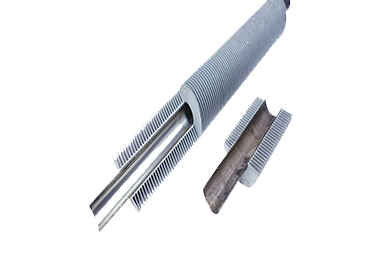
6.1 Aluminium G Fin Tubes
Aluminium fins provide:
- Lightweight structure
- Excellent thermal conductivity
- Good corrosion resistance
Hence, aluminium G fin tube are mostly used in a air cooling system.
6.2 Copper G Fin Tubes
Because the heat transfer performance of copper fins is great.
This makes them suitable for high thermal conductivity applications.
6.3 Steel G Fin Tubes
Steel base tubes provide:
- High strength
- Good pressure resistance
- Industrial durability
Therefore, they support heavy-duty applications.
G Fin Tubes Applications
G fin tube has many applications in different industries.
7.1 Air Cooled Heat Exchangers
Efficient air-side heat transfer is crucial for air cooled heat exchangers.
Hence, the G fin tube are employed commonly in:
- Oil coolers
- Gas coolers
- Process cooling equipment
7.2 Petrochemical Industry
As for petrochemical plants, they need trust-worthy heat transfer parts.
Therefore, G fin tube support:
- Refinery equipment
- Condensers
- Cooling systems
7.3 Power Generation
The G fin tube are used in the Power Plants as:
- Heat recovery systems
- Cooling units
- Boiler auxiliary equipment
7.4 HVAC Industry
Heat exchangers for HVAC applications must be small and high-efficiency.
Therefore, G fin tube support:
- Heating equipment
- Cooling systems
- Ventilation systems
7.5 Industrial Refrigeration
The definition of refrigerator system involves the efficient thermal exchange.
Thus, G fin tube ensure system performance improvement.
G Fin Tubes vs L Fin Tubes
Feature | G Fin Tubes | L Fin Tubes |
Fin Connection | Embedded groove | Wrapped foot |
Bond Strength | Higher | Medium |
Temperature Resistance | Higher | Lower |
Mechanical Stability | Excellent | Good |
Manufacturing Cost | Higher | Lower |
Application Level | Industrial | General |
Thus, G fin tube are appropriate for processes that need a higher strength bond and high-end temperatures.
In this Articlewhat to look for when selecting G fin tube
How to Select Suitable G fin Tubes
Operating Temperature
Strong bonding is needed for high-temperature applications.
So, that makes the G fin tube fitting from more critical conditions.
Material Compatibility
Consider:
- Tube material
- Fin material
- Working fluid
Hence the materials are chosen according to operating conditions.
Heat Transfer Requirements
Evaluate:
- Fin height
- Fin density
- Tube diameter
These factors influence thermal performance.
Application Environment
Outdoor systems require corrosion-resistant materials.
As a result aluminium fins are selected in most cases.
Supplier Experience
Choose suppliers with:
- Professional engineering capability
- Production experience
- Quality control systems
Bangwin Thermal supplies G fin tube on the demands of our customer.
Visit:
Bangwin Thermal Official Website
Why Choose Bangwin Thermal
Bangwin Thermal specializes in fin tube manufacturing & heat exchanger.
Our advantages include:
- Professional fin tube engineering
- Customized product design
- Advanced manufacturing equipment
- Strict quality inspection
- Global export experience
- Technical support
In addition, we offer complete Solutions like:
- G fin tube
- Spiral fin tubes
- Laser welded fin tubes
- High frequency welded fin tubes
- Heat exchanger components
For related industrial products, visit:
FAQ
- What are G fin tubes?
G fin tubes are finned tubes that use embedded grooves to mechanically lock fins onto the tube surface.
- Why are G fin tubes popular?
They provide strong bonding, high temperature resistance, and excellent heat transfer performance.
- What materials are used for G fin tubes?
Common materials include aluminium fins, copper fins, carbon steel tubes, and stainless steel tubes.
- Where are G fin tubes used?
They are used in heat exchangers, petrochemical systems, power plants, HVAC equipment, and industrial cooling systems.
- What is the difference between G fin tubes and L fin tubes?
G fin tubes use embedded fins, while L fin tubes use wrapped fins. G fin tubes provide stronger bonding.
- Can Bangwin Thermal manufacture customized G fin tubes?
Yes. Bangwin Thermal provides customized fin tube solutions based on customer specifications.
Conclusion
G Fin Tubes are efficient and reliable heat transfer solutions designed for modern-day needs.
These provide strong fin bonding, great thermal and high temperature performance with long life.
In conclusion, G fin tubes are still a critical option for industrial heat exchanger applications.
Through years of production experience and professional skills Bangwin Thermal offers customized G fin tube solutions and full equipment service for global customers.
Visit:
Bangwin Thermal