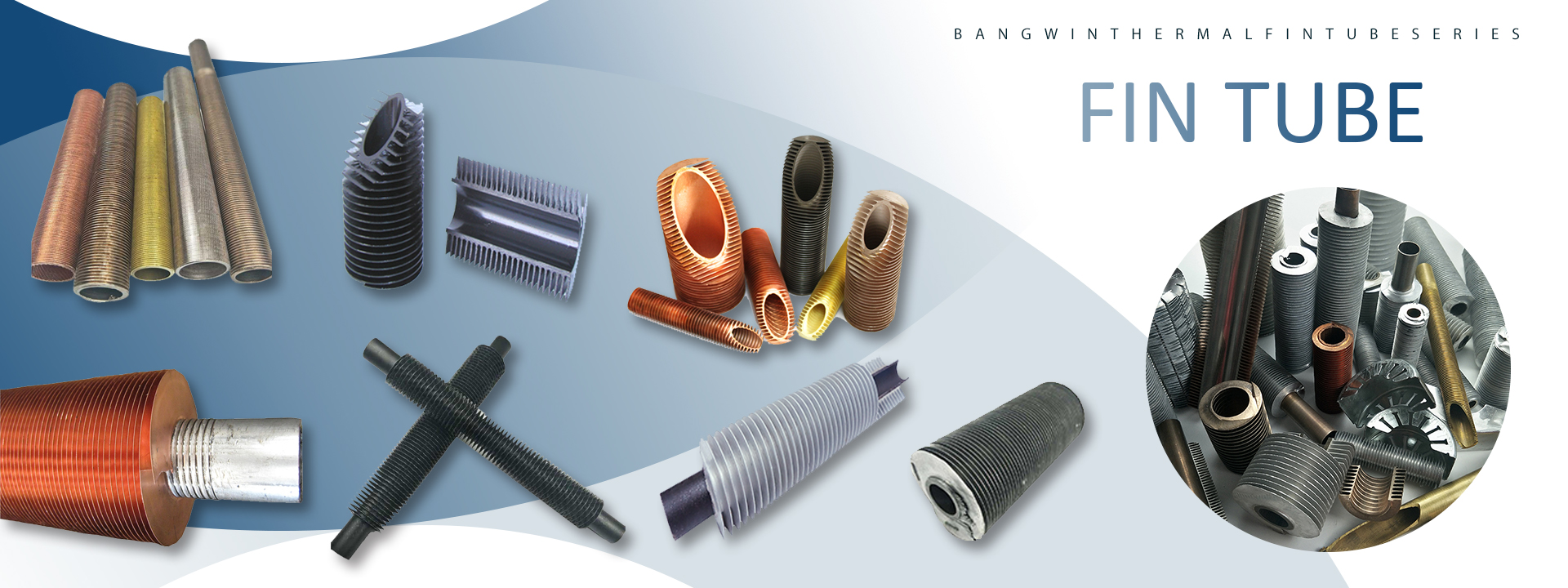
Complete Engineering Guide to Laser Welded Fin Tubes in Heat Recovery Equipment
1. Direct Answer: What Is a Tubo de aleta soldado por láser?
A tubo de aleta soldado por láser is an extended-surface heat transfer tube in which a fin strip is joined to the base tube by a focused laser beam that melts a narrow strip of parent metal on both components, producing an autogenous fusion weld without filler wire. The process concentrates thermal energy into a weld zone typically a few tenths of a millimetre wide, so the base tube wall keeps its mechanical properties and the tube stays straight. Laser finning is chosen for thin-wall tubes, stainless and high-alloy base pipes, and applications where weld distortion or heat damage cannot be tolerated.
Laser welding is not a universal replacement for high-frequency resistance welding. It trades line speed for precision. Engineers specify a tubo de aleta soldado por láser where the tube wall is too thin for resistance welding, where the alloy is heat-sensitive, or where the weld must be visually and dimensionally near-invisible.
2. How the Laser Finning Process Works
Laser finning is a continuous, automated process combining tube rotation, axial travel, and a fibre-delivered laser beam tracked to the fin-to-tube junction.
The Production Sequence
Preparación del tubo base
- : The tube is straightened, cleaned, and degreased. Laser welding tolerates less surface contamination than resistance welding because there is no forging action to squeeze oxides out of the joint.
Alimentación de tiras de aletas
- : A flat strip is fed at a controlled helix angle. No pre-profiling is required for the weld itself, because the laser fuses the strip edge directly to the tube surface.
Beam delivery and focus
- : A fibre laser, typically in the 1–4 kW class for this application, is focused to a spot of a few tenths of a millimetre at the joint line. Shielding gas protects the molten pool from oxidation.
Continuous fusion
- : The beam travels with the helix, melting a narrow band of the fin edge and the tube surface. The two molten zones merge and solidify as one continuous weld bead, with no filler addition.
Inspection and finishing
- : The weld bead is inspected visually and dimensionally. Where specified, tubes are pickled or passivated after welding, particularly for stainless grades.
Because the beam position is set by optics rather than by mechanical squeeze rolls, weld placement is repeatable run to run. That repeatability is why laser finning suits automated cells producing long, thin-wall tubes for compact heat exchangers.
3. Heat-Affected Zone Control: The Core Technical Advantage
The heat-affected zone (HAZ) is the band of base metal that has been thermally altered but not melted. Its width governs distortion, corrosion behaviour, and residual stress.
Resistance welding heats a comparatively wide region because current spreads through the contact area. Laser welding delivers energy in a short interaction time with a steep thermal gradient, so the HAZ stays narrow — commonly a fraction of a millimetre on thin sections, though the exact width depends on power density, travel speed, and material conductivity.
Why a Narrow HAZ Matters in Practice
Base tube integrity
- : A thin-wall tube welded by resistance methods can suffer wall thinning or local annealing. Laser welding keeps the pressure boundary close to its as-supplied condition.
Distortion control
- : Narrow heat input means minimal bending and ovality change, which matters for tubes that must slide into tube sheets or pass through close-pitch bundles.
Resistencia a la corrosión
- : Austenitic stainless steels are sensitive to sensitisation — chromium carbide precipitation in the 450–850°C range — which degrades grain-boundary corrosion resistance. A narrow HAZ limits the volume of material exposed to that temperature band.
Dissimilar metal joints
- : Low total heat input reduces the brittle intermetallic layer that forms when welding dissimilar alloys, a common failure mode in aluminium-to-steel and copper-to-steel finning.
4. Laser Welding vs. High-Frequency Welding vs. Embedded Fins
Process selection should follow wall thickness, alloy, production volume, and inspection requirements.
Process Comparison
Factor | Tubo de aleta soldado por láser | High-Frequency Welded Fin Tube | G Type Embedded Fin Tube |
Energy source | Focused fibre laser beam | High-frequency resistance current | Mechanical roll embedding |
Weld type | Autogenous fusion, no filler | Solid-state forge weld | No weld — fin rolled into groove |
Heat-affected zone | Narrow (sub-millimetre typical) | Wider, with forging squeeze | Localised groove deformation |
Minimum practical wall | Thin walls feasible | Requires enough wall for forging load | Requires wall thickness for groove depth |
Typical line speed | Baja | Más alto | Moderado |
Distortion | Very low | Low to moderate | Bajo |
Best fit | Thin-wall, stainless, high-alloy, precision bundles | High-volume carbon steel waste heat recovery | Boiler economizers at moderate temperature |
Relative cost | Higher per metre | Moderado | Moderate to high |
The practical rule: use high-frequency welding for high-volume carbon steel economizer work where line speed drives cost, and use laser welding where the tube wall, the alloy, or the dimensional tolerance rules out a forging process.
5. Material Combinations Suited to Laser Finning
Laser welding handles a narrower process window than resistance welding, but it works across a wider metallurgical range.
Stainless steel tube with stainless steel fin
- : Grades 304, 304L, 316L, 321, and 310S. The most common laser-finned combination for corrosive flue gas and food-grade process duty.
Carbon steel tube with carbon steel fin
- : Used where thin walls or tight ovality limits exclude forging processes.
Stainless fin on carbon steel tube
- : A cost-control strategy that puts corrosion resistance on the gas side while keeping the pressure boundary economical. Laser’s low heat input makes this dissimilar joint more repeatable than forging.
Nickel alloy and duplex tube with matching fin
- : For chloride-bearing or high-temperature service where standard austenitic grades fall short.
Copper and copper-nickel tube with copper fin
- : For marine and cooling duties where galvanic compatibility matters more than cost.
Aluminium fins are rarely laser welded to steel tubes. Aluminium forms brittle iron-aluminium intermetallics at the joint, and tension winding or bimetallic extrusion is the established route for that pairing.
6. Design Parameters: Fin Geometry, Wall Thickness, and Weld Bead
Laser finning allows finer geometry than forging processes, but the geometry must be specified explicitly rather than assumed.
Parameters to Fix in the Specification
Base tube outside diameter
- : Commonly 12.7 mm to 114.3 mm for laser-finned work, with 19.05 mm, 25.4 mm, and 38.1 mm the most frequent sizes.
Base tube wall thickness
- : Laser finning is often selected precisely because the wall is thin. State the minimum wall after welding, not only the nominal wall.
Altura de la aleta
- : 6 mm to 25 mm typical for laser-finned bundles; taller fins increase tip temperature drop and reduce fin efficiency.
Espesor de las aletas
- : 0.3 mm to 1.5 mm. Thin strip is where laser welding’s low heat input earns its cost.
Paso de aleta
- : 2 to 10 fins per inch. Wide pitch for dirty gas, tight pitch for clean gas with space constraints.
Weld bead width and height
- : Specify a maximum bead width and require a smooth, continuous bead with no undercut. Bead geometry directly affects both pressure drop and cleanability.
Fin efficiency falls as fin height rises, because the tip runs cooler than the root. Taller fins therefore add surface area without adding proportional duty — a point worth checking before specifying maximum fin height to save tube count.
7. Where Tubo de aleta soldado por lásers Are the Correct Choice
Laser finning wins in applications where the process physics matter more than the metre price.
Compact heat exchangers with thin-wall tubes
- : Where a forging process would thin or deform the pressure boundary.
Stainless and high-alloy economizers
- : Where sensitisation and weld decay are real corrosion risks in condensing or chloride-bearing flue gas.
High-purity and process duty
- : Pharmaceutical, food, and semiconductor-adjacent cooling where weld cleanliness and minimal heat tint are required.
Dissimilar metal bundles
- : Stainless fin on carbon steel tube, or copper alloy combinations where intermetallic growth must be limited.
Precision replacement bundles
- : Where the replacement must fit an existing header and tube sheet without re-machining, and dimensional drift is unacceptable.
Research and pilot plants
- : Small quantities where tooling cost for a forging line cannot be justified but weld quality still matters.
Laser finning is also used for heat recovery in small modular systems and for prototypes that later move to high-frequency production once the design is fixed — a sensible way to validate geometry before committing to tooling.
8. Limitations and Common Specification Mistakes
Laser finning has real constraints. Ignoring them produces either an overpriced tube or a failed bundle.
Specifying laser welding for high-volume carbon steel work.
- Line speed is lower than resistance welding, so unit cost rises without a technical benefit. Use laser only where its precision is needed.
Underestimating surface cleanliness requirements.
- Laser welds do not forge out contamination. Oily or scaled strip produces porosity that a resistance weld would have squeezed away.
Assuming a narrow HAZ means no distortion at all.
- Thin walls still move. Specify straightness tolerance explicitly rather than relying on the process.
Ignoring weld bead profile in pressure drop calculations.
- A proud bead adds roughness and drag on the gas side; a concave or undercut bead weakens the joint.
Forgetting post-weld treatment for stainless grades.
- Where pickling or passivation is required, state it in the purchase order. Weld tint left in place becomes a corrosion initiation site.
Treating laser and resistance welded tubes as interchangeable in a thermal rating.
- Weld geometry and fin root contact differ, so re-rate the bundle rather than substituting metre for metre.
9. Quality Verification for Tubo de aleta soldado por lásers
Laser welds are small, so verification must be deliberate rather than visual only.
Verification Package to Require
Weld bead dimensional check
- : width, height, and continuity along the full tube length, recorded per tube or per batch.
Penetration assessment
- : metallographic cross-section on a sample from each production run, showing fusion into both the fin edge and the tube wall without excessive penetration into the pressure boundary.
Peel or bend test
- : confirms the fin tears in parent metal rather than separating at the weld.
Hardness traverse across the HAZ
- : particularly for stainless and alloy steels, to detect local hardening or softening.
Pressure test
- : hydrostatic or pneumatic test of the base tube or completed bundle, with recorded pressure and hold time.
Surface condition record
- : weld tint, spatter, and post-weld treatment confirmation.
Material traceability
- : certificates to EN 10204 3.1 for tube and strip, traceable to heat numbers.
A supplier who cannot provide a cross-section from a recent production run is offering an unverified process. Cross-sections are inexpensive and are the single most informative document for a tubo de aleta soldado por láser order.
10. Sourcing Tubo de aleta soldado por lásers from Nanjing Bang Win
Nanjing Bang Win Thermal Equipment Co., Ltd. manufactures industrial heat exchangers, finned tubes, and finning machinery, covering engineering, design, production, and sales in-house.
Capabilities Relevant to Laser-Finned Projects
Multiple finning routes
- : High-frequency welded, L type, LL type, KL type, G type embedded, and extruded finned tubes, plus laser welded configurations for thin-wall and high-alloy duty. Process selection is made against operating temperature and wall thickness rather than against a single product line.
Material range
- : Carbon steel, chrome-moly alloy steels, stainless grades including 304L, 316L, 321, and 310S, plus copper and copper-nickel base tubes.
Bundle fabrication
- : Finned tube bundles, economizer banks, and replacement assemblies manufactured to customer drawings.
In-house equipment engineering
- : The company also builds finning machinery, which means process parameters are developed and controlled internally rather than inherited from a third-party line.
Export delivery
- : Seaworthy crating and bundle framing for international projects.
Send your tube drawing, operating temperature, flue gas composition, and required test scope for a technical review through intercambiador de calor industrial personalizado.com.
11. Preguntas más frecuentes (FAQ)
What is the difference between a tubo de aleta soldado por láser and a high-frequency welded fin tube?
A tubo de aleta soldado por láser joins fin to tube with a focused beam that melts a narrow band of parent metal. A high-frequency welded tube uses resistance current plus mechanical forging pressure. Laser gives a narrower heat-affected zone and less distortion; high-frequency gives higher line speed and lower cost per metre on carbon steel work.
What is the minimum tube wall thickness for laser finning?
Laser finning is generally viable on thinner walls than forging processes, because there is no squeeze load on the tube. The practical minimum depends on alloy and required pressure rating, so specify the minimum wall after welding and let the manufacturer confirm feasibility rather than assuming a fixed figure.
Can aluminium fins be laser welded to steel tubes?
This pairing is uncommon. Aluminium and steel form brittle intermetallic compounds at the joint, and the established routes for aluminium finning are tension winding (L, LL, KL types) and bimetallic extrusion. Laser welding is normally applied to steel-to-steel, stainless, nickel alloy, and copper alloy combinations.
Does laser welding weaken the base tube?
A correctly set laser weld penetrates the tube wall only slightly, so the pressure boundary retains most of its as-supplied properties. The risk arises when power density is set too high. Require a metallographic cross-section and a hardness traverse to confirm penetration depth and HAZ condition.
How is the weld quality of a tubo de aleta soldado por láser inspected?
Typical checks include weld bead dimensional measurement, metallographic cross-section for penetration, a peel or bend test to confirm parent-metal failure, hardness testing across the heat-affected zone, and hydrostatic pressure testing of the base tube or bundle.
Is laser finning more expensive than high-frequency welding?
Per metre, laser finning generally costs more because line speed is lower and equipment capital is higher. The comparison changes when the alternative is a thicker wall to survive forging, post-weld straightening, or a higher alloy to tolerate a wider HAZ — in those cases the total bundle cost can favour laser.
12. Conclusion and Specification Checklist
A tubo de aleta soldado por láser is the right answer when precision matters more than production rate: thin walls, stainless and high-alloy service, dissimilar metal joints, and replacement bundles that must fit existing hardware without rework.
Specification Checklist Before Requesting Quotation
- State base tube grade, outside diameter, and minimum wall thickness after welding.
- Define fin material, height, thickness, and fins per inch.
- Specify maximum weld bead width and required bead profile.
- State operating temperature, flue gas composition, and cleaning method.
- Confirm whether pickling, passivation, or coating is required.
- Require cross-section, peel test, hardness traverse, and pressure test records.
- Fix straightness and ovality tolerances rather than relying on process defaults.
- Agree packaging and documentation before release.
For process selection support or a quotation against your drawings, contact the engineering team at Nanjing Bang Win Thermal Equipment Co., Ltd..