1. Introducción
Industrial Heat Exchangers have to be fast and reliable. That is why high frequency welding finned tube technology is used by manufacturers for industrial heat exchangers.
Typical fins are attached with weaker bonding strength. High frequency welding creates robust and seamless fin to tube connection. Thermal efficiency gets a boost because of better heat transfer.
Industries using high frequency welded finned tubes these days include petrochemical, power generation, HVAC, marine engineering and waste heat recovery. Automated welding technology allows for faster production and more repeatable products.
Bangwin Thermal carries industrial grade heat transfer solutions that service customers worldwide. Please visit Bangwin Thermal to find custom finned tube and heat exchanger solutions for your industry.
2. What Does High Frequency Welding Finned Tube Mean?
A high frequency welding finned tube has continuous metal fins welded onto a base tube via high frequency electrical currents.
The process often involves winding a steel fin strip helically around the tube. Heat is created at the point of contact by way of the high frequency current. As a result, the fin becomes strongly bonded to the tube through a continuous weld.
This method is different from mechanically winding fins around a tube. With high frequency welding, a metallurgical bond is formed. This creates better thermal conductivity and durability for the tube.
Typically, fin tubes are made from carbon steel, stainless steel or alloy materials. Furthermore, fin pitch, fin height and tube diameters can be customized to fit specific industrial needs.
A majority of the companies looking for high frequency welding finned tube are in need of dependable thermal efficiency in high temperature applications. As a result, high frequency welding stays very popular around the globe.
You can educate yourself on industrial welding specifications by consulting the American Welding Society or other industry outlets such as Heat Exchanger World.
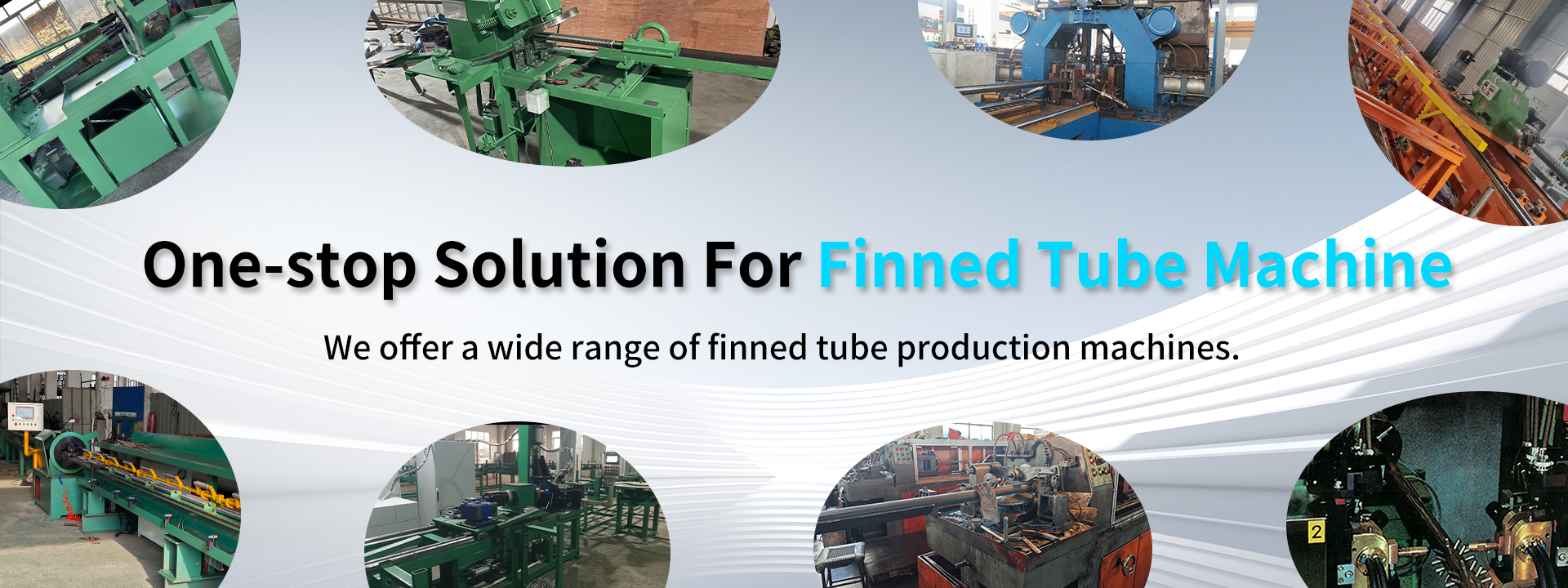
3. How Fin Welding Machine Works
High frequency welding finned tube is produced via continuous manufacturing. Operators begin by feeding the base tube into the system.
The machine automatically feeds the metal fin strip. Rotating systems then wind the fin strip around the tube in a helical fashion.
At the same time, high frequency electrical current is applied to the contact point. Localized heat is instantly generated and welds the fin to the tube.
Many systems are equipped with servo controls and PLC automation technology as well. This allows operators to ensure consistent fin spacing and weld quality.
The manufacturing process typically involves the following steps:
- Alimentación por sonda
- Feed fin strip
- Wind spiral fin
- High frequency weld
- Refrigeración
- Corte
- Control de calidad
Due to the efficiency of this automated process, production is able to improve.
Many production facilities couple these systems to a finned tube heat exchanger production line.
4. Componentes de High Frequency Welding Finned Tube Detail
There are some structural components of High frequency welded finned tube. Every single components also help provide thermal efficiency.
1.High Frequency Welded Fin Tube Detail
4.1 Tube
The tube process fluid during heat transfer process.
4.2 Aleta
The fin enlarge exterior surface area of heat transfer.
4.3 Welded connection
Connection provide good heat transfer from fin to tube.
4.4Helical Fin
Helical finning helps good turbulence and thermal effectiveness.
4.5Coating
Anti corrosion coating is applied for long term usage. (optional)
Most production lines include interface to the heat exchanger manufacturers automation system.
5.Different Types of High Frequency Welding Finned Tubes
There are several industries that require different finned tube structure. Hence suppliers offer various designs.
5.1 Solid Helical Finned Tube
Solid Helical Finned Tubes provide continuous solid fins meant for applications with highest thermal efficiency.
5.2 Serrated Finned Tube
These Finned Tubes use serrated fins to increase turbulence in airflow which enhances heat transfer performance.
5.3 Stainless Steel Finned Tube
To perform well in corrosive applications Stainless steel finned tube designs offer high corrosion resistance.
5.4 Carbon Steel Finned Tube
Carbon Steel finned tubes offer the perfect economical solution for industrial heating applications.
Buyers often look over designs which also include máquina de extrusión de tubos de aletas sistemas.
6 Benefits Of High Frequency Welded Finned Tubes
As you can see, there are many industrial benefits of using high frequency welding systems. That is why demand for high frequency welding continues to grow worldwide.
6.1 Stronger Bond Between Fin and Tube
Bonding is continuous welding, which creates a superior metallurgical bond. As a result, thermal efficiency increases.
6.2 Higher Heat Transfer Efficiency
In addition, helically applied fins greatly increase the surface area for heat transfer outside the tube.
6.3 Superior Mechanical Strength
Due to the welded construction, these systems can better withstand vibration and thermal stress.
6.4 Improved Performance at High Temperatures
Systems with high frequency welded tubes are more dependable at extreme temperatures.
6.5 Longer Service Life
The overall quality of the weld will greatly increase how long your system lasts.
Customers in many industries also pair these systems with industrial cooling for increased energy efficiency.
7 aplicaciones de High Frequency Welding Finned Tubes
HF welded finned tubes are used by many industries in their thermal transfer applications.
7.1 Industria petroquímica
Chemical plants are one industry that uses welded finned tubes for heating and cooling their process.
7.2 Power Generation
Generating plants utilize finned tube in boilers, economizers and heat recovery steam generators.
7.3 HVAC Industry
HVAC units need finned tubes for heating and cooling applications involving air transfers.
7.4 Waste Heat Recovery
Industrial plants implement finned tube heat exchangers for waste heat recovery systems.
7.5 Marine Engineering
Cooling systems for boats use finned tube heat exchangers because they need to withstand corrosive environments.
Customers often come looking for types of industrial heat exchangers when researching HF welded fin tube systems.
8. Difference between High Frequency Welding Finned Tube and Extruded Fin Tube
The differences between welding and extrusion fin tube technologies are compared by many manufacturers before purchasing.
Strong welded bonding and great high temperature resistance are offered by high frequency welding finned tube. Extruded fin tube allows for much better corrosion resistance and seamless fin integration.
Flexible fin heights and configurations are enabled with welded fin tubes. That’s why you can find them being applied in large scale industrial heat exchangers extensively.
Nevertheless, extruded fin tubes may have better performances in marine and corrosive environment.
Many manufacturing companies install both kinds of technologies on their equipment.
9. How to Select High Frequency Welding Finned Tube
Selecting the right kind of finned tube not only enhances heat transfer performance but also increases the reliability of your equipments. Here are some important factors that you need to consider when making your selection.
9.1 Application Temperature
Choose appropriate tube material and fin material that can handle high temperature when your project involves high temperature.
9.2 Corrosive Environments
Stainless steel materials or alloy should be used when your equipment is exposed to corrosion.
9.3 Fin Shape
Different fin height and fin pitch are suitable for different applications.
9.4 Heat Transfer Load
The amount of heat you need remove directly influences your choice of finned tubes.
9.5 Maintenance Consideration
If you can provide accessible area for cleaning, you can improve your heat exchanger operation efficiency.
You can find customized finned tube options on Bangwin Thermal Official Website.
10. Tips on Maintainace and Cleaning
Routine maintenance helps operators lengthen finned tube life and heat transfer performance.
Operators can begin by inspecting fin surfaces on a routine basis.
Follow this tip by gently brushing away dust and fouling from fin surfaces.
Operators can use compressed air to clean the fins which improves airflow performance.
They can also use chemical means to clean industrial fouling from the fins.
Continually inspect welds and corrosion to catch issues with your exchanger early on.
Factories may wish to utilize professional heat exchanger cleaning and maintenance guides.
11. Why Select Bangwin Thermal?
Bangwin Thermal offers professional industrial heat transfer solutions to customers around the world. We also can assist you with custom finned tube manufacturing needs.
Why select Bangwin Thermal?
- Advanced welding techonology
- Fully customized finned tube solutions
- Calidad del producto garantizada
- Expert engineering
- Precios competitivos
- Experienced in exporting goods worldwide
Our team also has a strong understanding of industrial heat exchanger units.
Customers around the world rely on Bangwin Thermal to provide them with complete finned tube and thermal manufacturing answers. Check out Bangwin Thermal for more industrial thermal solutions.
- Más información sobre fabricación industrial:
- https://bangwingascylinder.com/
12. FAQ
Q: What is high frequency welding finned tube?
R: High frequency welding finned tube produces continuous welded fins on metal tubes by utilizing high frequency current.
Q: Which industries use high frequency welded finned tubes?
A: Industries that use high frequency welded finned tubes include petrochemical, HVAC, power generation, marine and waste heat recovery.
Q: What materials are used for high frequency welded finned tubes?
A: Commonly carbon steel, stainless steel and alloy materials are utilized in high frequency welded fin tube systems.
Q: What are the advantages of welded finned tubes?
R: High frequency welding finned tubes offer advantages such as strong weld bonding, high efficiency heat transfer and resistance to high temperatures.
Q: What is the difference between welded fin tubes and extruded fin tubes?
A: Welded fin tubes use continuous welding technology to affix the fins to the tubes. Extruded fin tubes have fins that are formed out of the outer layer of metal.
Q: Where can I buy industrial high frequency welded finned tubes?
A: Visit Bangwin Thermal Official Website to find industrial finned tube solutions.
13. Conclusión
High frequency welding finned tube is an effective method to ensure heat exchangers are durable and efficient. As a result, many manufacturers are implementing welded fin tube technology into their industrial thermal systems.
Not only do high frequency welded fins offer better heat transfer efficiencies, but they also have better mechanical properties and reliability. This is why high frequency welded finned tubes will continue to be used in industrial heat exchangers.
At Bangwin Thermal we offer professional industrial heat transfer and finned tube solutions to customers around the world. We also offer customizations to our thermal systems to fit your specific industry.
Looking for quality finned tube manufacturing solutions? Contact Bangwin Thermal today.